





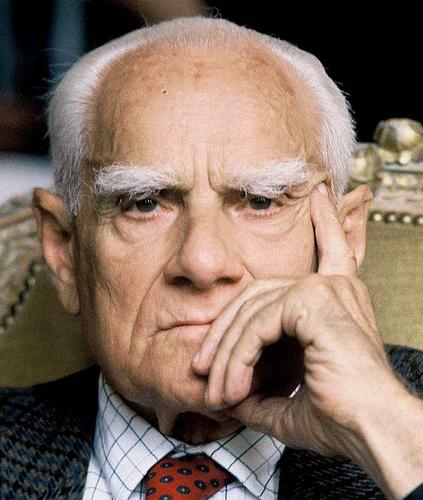
Author
Alberto Moravia
28 nov 1907 – 26 sep 1990
Alberto Moravia is an Italian journalist, short-story writer, and novelist known for his fictional portrayals of social alienation and loveless sexuality. He was a major figure in 20th-century Italian literature. Moravia contracted tuberculosis of the bone (a form of osteomyelitis usually caused by Mycobacterium tuberculosis) at the age of 8, but, during several years in which he was confined to bed and two years in sanatoriums, he studied French, German, and English; read Giovanni Boccaccio, Ludovico Ariosto, William Shakespeare, and Molire; and began to write. Moravia was a journalist for a time in Turin and a foreign correspondent in London. His first novel, Gli indifferenti (1929; Time of Indifference), is a scathingly realistic study of the moral corruption of a middle-class mother and two of her children. It became a sensation. Some of his more important novels are Agostino (1944; Two Adolescents); La Romana (1947; The Woman of Rome); La disubbidienza (1948; Disobedience); and Il conformista (1951; The Conformist), all on themes of isolation and alienation. La ciociara (1957; Two Women) tells of an adaptation to post-World War II Italian life. La noia (1960; The Empty Canvas) is the story of a painter unable to find meaning either in love or work. Many of Moravia's books were made into motion pictures. His books of short stories include Racconti romani (1954; Roman Tales) and Nuovi racconti romani (1959; More Roman Tales). Racconti di Alberto Moravia (1968) is a collection of earlier stories. Later short-story collections include Il paradiso (1970; “Paradise”) and Boh (1976; The Voice of the Sea and Other Stories). Most of Moravia's works deal with emotional aridity, isolation, and existential frustration and express the futility of either sexual promiscuity or conjugal love as an escape. Critics have praised the author's stark, unadorned style, his psychological penetration, his narrative skill, and his ability to create authentic characters and realistic dialogue. Moravia's views on literature and realism are expressed in a stimulating book of essays, L'uomo come fine (1963; Man as an End), and his autobiography, Alberto Moravia's Life, was published in 1990. He was married for a time to the novelist Elsa Morante. Copyright © 1994-2011 Encyclopædia Britannica, Inc. For more information visit Britannica.com - [Source][1] [1]: http://www.biography.com/people/alberto-moravia-9414103
Bibliography
Books
30 books


Great Short Stories of the World
1972
Isak Dinesen, Sholem Aleichem, Aldous Huxley, Irwin Shaw, Reader's Digest Association, Truman Capote, Dorothy L. Sayers, Ernest Hemingway, Nigel Balchin, William Somerset Maugham, Santha Rama Rau, Albert Camus, Katherine Anne Porter, Mark Twain, John Steinbeck, Anatole France, Антон Павлович Чехов, Nadine Gordimer, Bertolt Brecht, Graham Greene, Frank O'Connor, Katherine Mansfield, Corrado Alvaro, Sally Benson, John Updike, Damon Runyon, Pearl S. Buck, Jessamyn West, Shirley Jackson, Alberto Moravia, H. G. Wells, Lilika Nakos, Oscar Wilde, Guy de Maupassat, James Joyce, Joseph Conrad, Rabindranath Tagore, Rumer Godden, Hernando Tellez, D. H. Lawrence, Robert Benchley, John O'Hara, S. J. Perelman, Machado de Assis, Jean Stafford, Max Aub, Gabrielle Roy, James Thurber, Leo Kennedy, Dorothy Parker, Stephen Crane, Montague Rhodes James, Максим Горький, Gregorio Lopez y Fuentes, Josh Gregory, Doris Lessing, Saki, Wallace Stegner, Marcel Aymé, Colette, Ring Lardner, Paul Horgan, Thomas Head Raddall, O. Henry, Luigi Pirandello, Eudora Welty, F. Scott Fitzgerald, Mikhail Zoshchenko, Hjalmar Söderberg, Henry Lawson




Cover unavailable


