





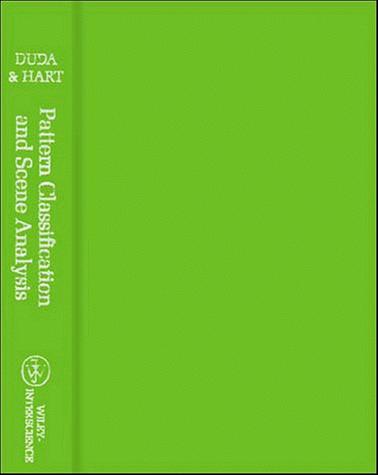
Pattern classification and scene analysis
5.0/ 5
2 ratings
About This Book
From the inside cover: Here is a unified, Comprehensive, and up–to–date treatment of the theoretical principles of pattern recognition. These principles are applicable to a great variety of problems of current interest, such as character recognition, speech recognition, speaker identification, fingerprint recognition, the analysis of biomedical photographs, aerial photoreconnaissance, automatic inspection for industrial quality control, and visual systems for robots. Throughout Pattern Classification and Scene Analysis, the authors have balanced their presentation to reflect the relative importance of the many theoretical topics in the field. Pattern Classification and Scene Analysis is the first book to provide comprehensive coverage of both statistical classification theory and computer analysis of pictures. Part I covers Bayesian decision theory, supervised and unsupervised learning, nonparametric techniques, discriminant analysis, and clustering. Part II describes many techniques of current interest in automatic scene analysis, including preprocessing of pictorial data, spatial filtering, shape–description techniques, perspective transformations, projective invariants, linguistic procedures, and artificial intelligence techniques for scene analysis. Although the theories and techniques of pattern recognition are largely mathematical, the authors have been more concerned with providing insight and understanding than with establishing rigorous mathematical foundations. The many illustrative examples, plausibility arguments, and discussions of the behavior of solutions reflect this concern. Extensive bibliographical and historical remarks at the end of each chapter further enhance the presentation. Standard notation is used wherever possible, and a comprehensive index is included. Typical first–year graduate students will find most of the mathematical arguments well within their grasp. Because the exposition is clear and balanced, Pattern Classification and Scene Analysis is suitable for both college and professional use. In particular, it will appeal to graduate students and professionals in the fields of computer science, electrical engineering, and statistics. Students and professionals in psychology, biomedical science, meteorology, and biology will also find it of value for the light it sheds on such areas as visual perception, image processing, and numerical taxonomy
Track Your Reading
Sign in to save this book, track pages, log finished reads and rereads, and build your Reading Diary.
Sign Instatisticspattern recognitionclassificationmachine learningcomputer sciencemathematicsStatistical decisionPattern recognition systemsPerceptronsPattern perception
The Swinging Light
Book Details
First Published
1973
Pages
482 pages
Rating
5.0 / 5
Ratings
2
Editions
1
Publisher
Wiley
Language
ENG
Status
Published
The People Behind The Book
Authors
You May Also Like
Recommended Books






Introductory statistics for the behavioral sciences
1971
Joan Welkowitz, Barry H. Cohen, Robert B. Ewen
