

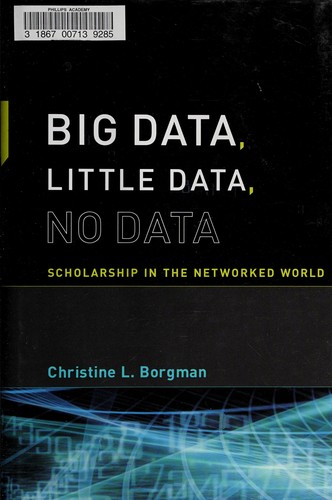
Big data, little data, no data
4.0/ 5
3 ratings
About This Book
"Big data" is on the covers of Science, Nature, the Economist, and Wired magazines, on the front pages of the Wall Street Journal and the New York Times. But despite the media hyperbole, as Christine Borgman points out in this examination of data and scholarly research, having the right data is usually better than having more data; little data can be just as valuable as big data. In many cases, there are no data - because relevant data don't exist, cannot be found, or are not available. Moreoever, data sharing is difficult, incentives to do so are minimal, and data practices vary widely across disciplines. Borgman, an often-cited authority on scholarly communication, argues that data have no value or meaning in isolation; they exist within a knowledge infrastructure - an ecology of people, practices, technologies, institutions, material objects, and relationships. After laying out the premises of her investigation - six "provocations" meant to inspire discussion about the uses of data in scholarship - Borgman offers case studies of data practices in the sciences, the social sciences, and the humanities, and then considers the implications of her findings for scholarly practice and research policy. To manage and exploit data over the long term, Borgman argues, requires massive investment in knowledge infrastructures; at stake is the future of scholarship. -- from dust jacket.
Track Your Reading
Sign in to save this book, track pages, log finished reads and rereads, and build your Reading Diary.
Sign InTechnological innovationsInformation storage and retrieval systemsResearchMethodologyCyberinfrastructureData processingCommunication in learning and scholarshipInformation technologyResearch, methodologyResearch, data processingElectronic data processing, distributed processingDatenstruktur
The Swinging Light
Book Details
First Published
2015
Pages
383 pages
Rating
4.0 / 5
Ratings
3
Editions
1
Publisher
The MIT Press
Language
ENG
Status
Published
The People Behind The Book
Authors
You May Also Like
Recommended Books