

Rethinking expertise
0.0/ 5
0 ratings
About This Book
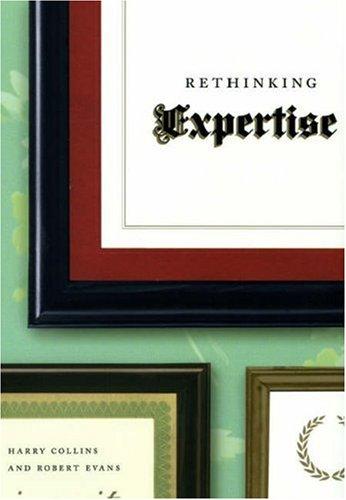
"What does it mean to be an expert? Traditionally, expertise has been associated with authoritative knowledge, honed by practice and certified by powerful institutions. Scientists, of course, are often presumed to be the ultimate experts, but it is exactly in this area that the importance of defining what it means to be an expert is paramount. In Rethinking Expertise, Harry Collins and Robert Evans offer a radical new perspective on the role of expertise in the practice of science and the public evaluation of technology." "Collins and Evans present the problem of expertise in the context of modern society and go on to offer a Periodic Table of Expertises based on the idea of tacit knowledge - in other words, knowledge that we have but cannot explain. They then explore how some expertises are used to judge others, how we judge between experts even when we are not experts ourselves, and how credentials are used to judge experts. A central new concept in the book and, the authors argue, in society, is interactional expertise - a proficiency in the language of a specialism if not in its practices. Here, they describe experiments in which people with interactional expertise showed themselves to be indistinguishable from full-fledged experts in imitation games." "Throughout, Collins and Evans ask an important question: how can the public make use of science and technology before there is consensus in the scientific community? This is a quandary that has wide implications for public policy and for those who seek to understand and benefit from science. The authors offer a balanced assessment of the main issues and propose a new understanding of how to extend public participation in technical decision-making without abandoning the idea of expertise as real, useful, and necessary.". "Rethinking Expertise will be of interest to scientists and scholars in science studies but will also have implications for decision makers and experts across many fields - in technology, education, sociology, legal studies, psychology, philosophy, computer engineering, and business."--BOOK JACKET.
Track Your Reading
Sign in to save this book, track pages, log finished reads and rereads, and build your Reading Diary.
Sign InSocial aspectsScienceSociology of KnowledgeExpertiseProfessional CompetenceWetenschapsbeleidWissenssoziologieDeskundigheidWetenschapsdynamicaFachwissenPhilosophy & Social AspectsKnowledge, sociology of
The Swinging Light
Book Details
First Published
2007
Pages
160 pages
Rating
0.0 / 5
Ratings
0
Editions
1
Publisher
University Of Chicago Press
Language
ENG
Status
Published
The People Behind The Book
Authors
You May Also Like
Recommended Books


Chemistry
1977
Theodore L. Brown, H. Eugene Lemay, Bruce E. Bursten, Catherine Murphy, Patrick Woodward, Catherine J. Murphy, James C. Hill, Theodore E Brown, Julia R Burdge, Patrick M. Woodward, Matthew W. Stoltzfus, Brown, Theodore, Jr., Linda S. Brunauer, Julia R. Burdge

The science of getting rich, or, financial success through creative thought
1910
Wallace D. Wattles, Ruth L Miller, Patricia J. Crane, Rick Nichols